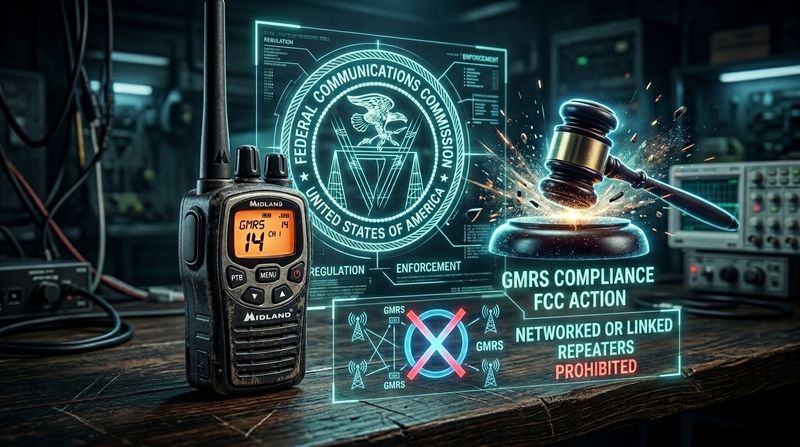


GMRS data normally comes with a simple timing rule: digital transmissions may last no more than one second and generally cannot be sent more frequently than once every 30 seconds.
But in January 2025, the FCC gave Garmin permission to operate differently.
In DA 25-16, an order adopted and released on January 7, 2025, the FCC’s Wireless Telecommunications Bureau granted Garmin a limited waiver allowing qualifying handheld GMRS devices to transmit certain automatic digital data as often as once every five seconds.
That sounds like a major change—and technically, it is. But it does not mean that every GMRS radio can suddenly start transmitting data six times as often.
The FCC did not rewrite the GMRS rules. It granted a specific exception, with several conditions designed to protect voice communications. Understanding that distinction tells us quite a bit about both the current limits of GMRS data and where manufacturers may want to take it next.
Why Garmin Needed a Waiver
For most GMRS equipment, the familiar rules still apply.
Section §95.1787 limits an individual digital data transmission to no more than one second. It also generally limits those transmissions to one during any 30-second period, aside from an exception allowing a radio to automatically answer more than one location interrogation request during that period.
Those restrictions help explain why GMRS data has traditionally been better suited to brief location updates and short messages than rapid tracking or continuous telemetry.
And importantly, that regulation is still in place. As of October 2026, the current version of §95.1787 continues to contain the one-transmission-per-30-seconds requirement.
The Garmin decision is therefore best understood as an exception to the existing rule—not a replacement for it.
What Garmin Wanted to Do Differently
Garmin filed its waiver request in October 2023 while seeking equipment certification for handheld GMRS radios designed to provide more frequent digital updates.
The issue was position reporting.
Instead of automatically transmitting digital information only once every 30 seconds, Garmin wanted its devices to be able to send a data burst once every five seconds. The company argued that more frequent updates could provide more useful location information when users are moving, particularly in remote areas with limited cellular coverage.
But Garmin was not proposing five-second-long transmissions—or even one-second transmissions every five seconds. Each proposed burst would last no more than 50 milliseconds, or just five hundredths of a second.
Purchase Guide
Garmin Rino 750t
Rugged 5W Handheld GMRS Radio with Touchscreen Navigation and Preloaded TOPO U.S. 100K Maps

That difference matters.
At the respective nominal maximum rates, twelve 50-millisecond transmissions in one minute occupy about 0.6 seconds of airtime, or roughly 1% of the minute. Two one-second transmissions occupy two seconds, or about 3.3%.
In other words, Garmin proposed transmitting more frequently but for substantially less total time. The FCC specifically noted that while Garmin’s transmissions would occur more often, their shorter duration would consume less time overall than transmissions using the normal one-second maximum.
Five-Second Updates Came With Strings Attached
The FCC granted Garmin’s waiver in DA 25-16, but it did not simply replace “30 seconds” with “five seconds.” The authorization came with several significant restrictions.
First, operation under the waiver is limited to the upper three 462 MHz interstitial channels: channels 5, 6, and 7. Those correspond to 462.6625, 462.6875, and 462.7125 MHz. Garmin therefore did not receive permission to use the rapid-data feature throughout the GMRS channel plan.
Second, each transmission must remain extremely short. Data can be sent no more frequently than once every five seconds, and each burst is limited to 50 milliseconds.
Third, the devices must protect ongoing voice communication through a listen-before-talk system. Except when the device determines that its user is experiencing a safety-of-life situation, it must listen for voice activity before using the faster data feature. If another GMRS user is detected speaking on the channel, the 50-millisecond rapid-data feature must be suspended.
And the restriction does not disappear as soon as the conversation ends.
Before the device can resume transmitting data every five seconds, that channel must remain clear of voice communications for at least one hour. During that period, the device can return to the normal data-transmission duty cycle permitted under §95.1787 rather than continuing the special five-second operation.
The FCC also prohibited end users from being able to modify the radios so that a safety-of-life or similar emergency setting could be permanently triggered simply to bypass the listen-before-talk protection.
Taken together, these conditions reveal an important part of the FCC’s reasoning. More frequent data may be possible on GMRS, but in this case it was allowed only alongside restrictions intended to keep voice communication from being crowded off the channel.
A Waiver Is Not a New GMRS Rule
This is the distinction GMRS operators should pay closest attention to.
An FCC waiver provides relief from a particular regulation under specified circumstances. It does not automatically change that regulation for everyone else. Garmin specifically received a waiver of §95.1787(a)(3) so that it could obtain equipment certification for handheld devices using the five-second data feature under the conditions established by the FCC.
Purchase Guide
Garmin Rino 750
Rugged 5W Handheld GMRS Two-Way Radio and GPS/GLONASS Navigator with Touchscreen
That does not mean an operator can configure another GMRS radio to send automatic position reports every five seconds and claim that Garmin established a new standard. It also does not mean firmware developers can simply duplicate the timing used by the Garmin equipment, or that every certified GMRS radio with data capability now receives the same exception.
For radios that are not operating under an applicable waiver or some future rule change, the ordinary requirements of §95.1787 remain the starting point.
The easiest way to remember the distinction is this: A waiver changes what specified equipment may do under specified conditions. A rule change changes what GMRS generally permits.
That difference becomes increasingly important as software-driven radios become capable of features that the regulations may not authorize for general GMRS use.
Could Five-Second GMRS Data Become More Common?
The Garmin waiver also contains a clue that the story may not end with one manufacturer’s products. As a condition of granting the waiver, the FCC required Garmin to file a Petition for Rulemaking within 60 days seeking regulatory changes that could permit more flexible use of the band. Garmin filed that petition on March 5, 2025.
The FCC subsequently assigned it RM-12018 and, on March 9, 2026, issued a public notice identifying Garmin’s request to amend §95.1787. That is an important next step, but it is not the same thing as changing the rule. A petition for rulemaking asks the FCC to consider modifying its regulations. Until the Commission completes the applicable rulemaking process and adopts a change, the existing regulation remains in force. And as of September 2026, that existing language still limits ordinary GMRS digital data to one transmission within a 30-second period.
Garmin is also no longer the only manufacturer testing these boundaries. In June 2026, the FCC sought public comment on a separate request from GME Pty Ltd that would, among other things, permit certain automatic GMRS data transmissions once every 15 seconds under specified conditions. GME cited the earlier Midland and Garmin waivers in support of its request.
So operators should separate two questions.
The first is whether the FCC is willing to consider more flexible GMRS data operation. The Garmin waiver—and other waiver proceedings—show that manufacturers are actively asking the Commission to consider such uses.
The second is whether GMRS operators generally have permission to use five-second automatic data today.
The Garmin waiver, by itself, does not provide that permission.
The Bottom Line
The Garmin decision is significant because it shows that GMRS data rules are being tested against capabilities that go beyond ordinary once-every-30-seconds operation.
The FCC allowed qualifying Garmin equipment to transmit data six times as frequently as the normal rule permits—but only with 50-millisecond bursts, operation on three specified channels, listen-before-talk protection, and a one-hour voice-clear requirement before rapid transmissions can resume.
That makes the waiver interesting both technically and regulatorily. It demonstrates one approach to making location-sharing more responsive while placing substantial protections around traditional GMRS voice use. But for operators, the distinction remains straightforward: the Garmin waiver may show one direction GMRS data could take, but a regulatory exception is not permission for everyone to follow it.