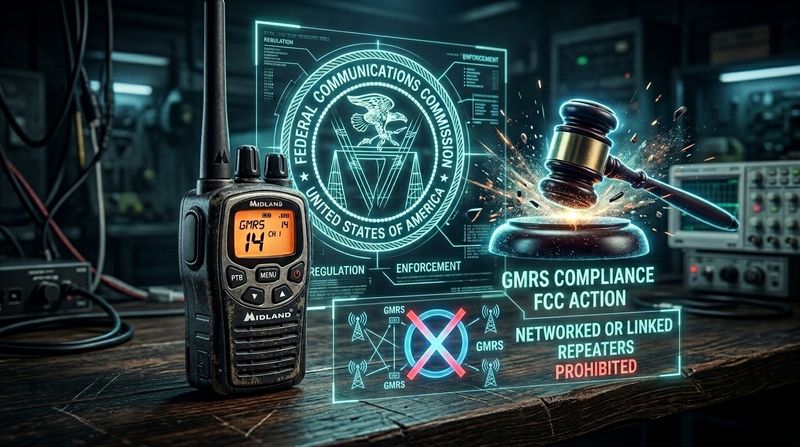

GMRS gives licensed individuals and their families a flexible way to communicate at home, on the road, outdoors, and through repeaters. But GMRS is not an unrestricted radio service. Its operating rules are established by the Federal Communications Commission (FCC) in 47 CFR Part 95, Subpart E.
For most operators, Subpart E answers four basic questions: who may use GMRS, what types of communication are allowed, how the channels and equipment may be used, and what conduct is prohibited. While Subpart E covers GMRS, it is important to note that Part A governs all Personal Radio Services (CB, FRS, GMRS, MURS, etc.). Part A applies to every service, but the specific subparts set rules for each individual service that can override the rules outlined in Part A.
This article provides a practical overview of those essential rules in plain language and is not a comprehensive interpretation of these rules. The rules covered in this article were based upon those in effect as of August 2026. These rules can be found by reviewing Title 47 of the Code of Federal Regulations.
Who Needs a GMRS License (47 CFR 95.1705)
A valid GMRS license is required to operate a GMRS station. The FCC issues the license to an individual, not to a specific radio, vehicle, home, or repeater.
The license holder may operate multiple GMRS radios and may allow qualifying immediate family members to operate under the same license. Covered relatives include spouses, parents, children, grandparents, grandchildren, siblings, aunts, uncles, nieces, nephews, stepparents, stepchildren, and in-laws.
Friends, neighbors, coworkers, club members, and unrelated employees are not automatically covered by another person’s license.
The license holder is responsible for ensuring that stations operated under the license follow the rules. This remains true when family members or minors are using the radios.
During an emergency, however, any person may be allowed to operate a licensed GMRS station when necessary to send an emergency message.
What Can You Talk About on GMRS? (47 CFR 95.1731)
GMRS may be used for plain-language, two-way voice communication involving personal or business activities.
That means operators may use GMRS for activities such as:
- Family coordination
- Road trips and vehicle convoys
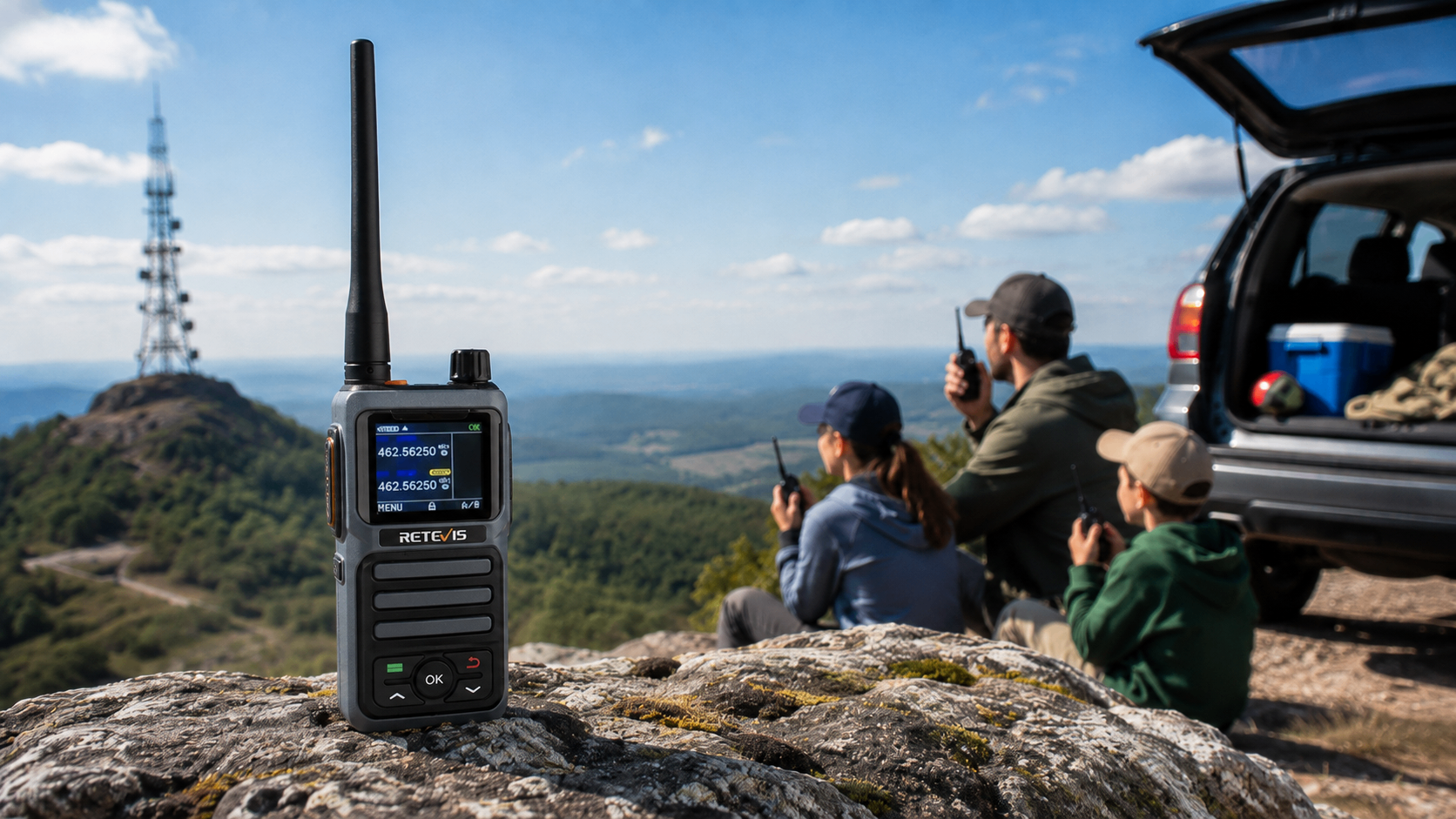
- Outdoor recreation
- Neighborhood communication
- Work-related coordination
- Traveler assistance
- Emergency communication
- Repeater conversations
- Brief radio tests
Business-related conversations are allowed, but this does not create a company-wide license. Each person operating a radio must still be properly licensed or covered by a qualifying family license.
GMRS operators may also communicate directly with Family Radio Service users on shared channels.
Emergencies Always Come First (47 CFR 95.1731 & 95.1733)
Any GMRS channel may be used for emergency communication or traveler assistance. Emergency traffic must be given priority over ordinary conversations.
Operators who hear a genuine emergency should avoid interfering and allow the channel to be used as needed.
The distress call “Mayday” should not be used casually. Under Subpart E, it is reserved for someone aboard a ship, aircraft, or other vehicle that is in immediate danger and needs assistance.
What is Not Allowed? (47 CFR 95.1733)
GMRS is intended for two-way communication, not broadcasting or entertainment.
Operators may not use GMRS to transmit:
- Music, sound effects, whistling, or entertainment
- Advertisements or sales offers
- False or deceptive messages
- Messages connected to illegal activity
- Deliberately coded messages intended to hide their meaning
- Political advertisements
- Continuous transmissions that unnecessarily occupy a channel
- Public-address announcements to a crowd or general audience
Common radio shorthand and “10 codes” are allowed. The restriction applies to messages deliberately designed to conceal their meaning.
Political campaign workers may discuss the actual operation of a campaign, but they may not broadcast political advertising over GMRS.
GMRS stations also may not normally communicate with amateur radio stations, unauthorized stations, or foreign stations. Emergency communication is the major exception.
One-Way Transmissions Are Limited (47 CFR 95.1731)
GMRS is primarily a two-way radio service. Routine one-way broadcasting is not permitted.
One-way transmissions are generally limited to:
- Emergency calls
- Warnings about hazardous road conditions
- Brief equipment tests
Calling another station to establish contact is permitted and is not treated as prohibited broadcasting. Certain short location and text-data transmissions are also allowed from compliant handheld radios.
Call Sign Identification (47 CFR 95.1751)
GMRS operators must identify their stations using the call sign assigned by the FCC.
The call sign must be transmitted:
- At the end of a transmission or series of transmissions
- At least once every 15 minutes during a longer conversation
- At the end of the conversation
The identification may be spoken in English or transmitted using audible Morse code.
Operators using multiple radios under one license may add unit identifiers, such as “Mobile 1” or “Unit 2,” after the call sign. These labels are optional and do not replace the FCC-assigned call sign.
You do not have to announce the call sign at the beginning of every transmission.
Channels, Power, and Repeaters (47 CFR 95.1763 - 95.1767)
GMRS has 30 authorized channels divided among several channel groups. Most consumer radios list 22 channels for general direct (simplex) communication, plus 8 dedicated main repeater input channels. The rules vary depending on the channel and the type of station being used.
The eight main 462 MHz channels may be used by handheld, mobile, base, fixed, and repeater stations. Mobile, base, and repeater stations may operate at up to 50 watts transmitter output power on the main channels, while fixed stations are limited to 15 watts.
Part 95, subpart E does not express every GMRS power limit in the same way. Some limits are based on transmitter output power, while others are based on effective radiated power (ERP). ERP accounts for the transmitter power along with feedline losses and antenna gain, so antenna system performance can affect whether a station remains within the applicable power limit.
The seven 462 MHz interstitial channels are shared with FRS and are limited to 5 watts effective radiated power.
The eight 467 MHz main channels are normally used as repeater inputs. They are not general-purpose high-power simplex channels.
The seven 467 MHz interstitial channels may be used only by handheld portable units and are limited to 0.5 watt effective radiated power.
The main practical lesson is that GMRS does not have one universal power limit. The legal limit depends on the channel and station type.
Repeaters are allowed and may operate automatically. A repeater owner may open the system to other users, limit it to approved users, or prohibit particular users when necessary. Holding a GMRS license does not automatically guarantee access to every privately operated repeater.
Use Certified GMRS Equipment (47 CFR 95.1761)
A transmitter used in GMRS must be properly certified for GMRS operation.
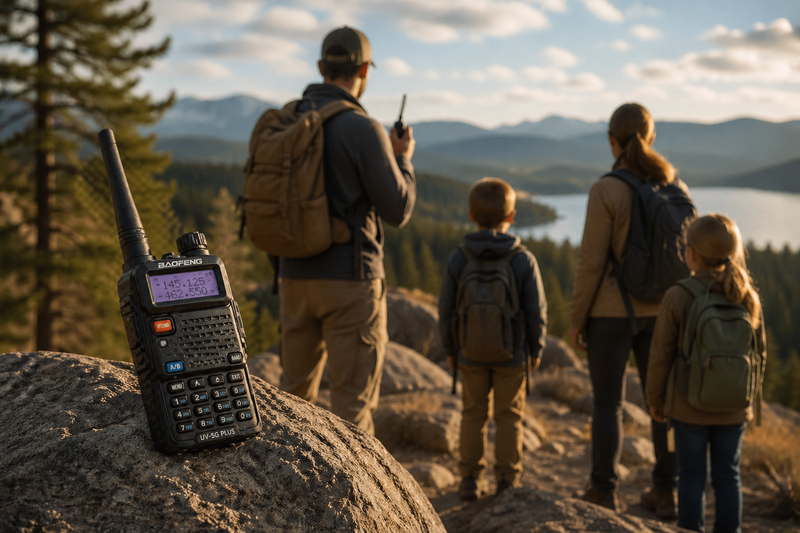
A radio is not automatically legal simply because it can be programmed to a GMRS frequency. Many amateur, commercial, or imported programmable radios can technically transmit on GMRS channels but do not have the required GMRS certification.
Certified GMRS radios are designed to follow the service’s frequency, power, bandwidth, emission, and operating restrictions. Operators should avoid modifying equipment in a way that enables unauthorized transmissions or causes the radio to operate outside its certification.
Under FCC Rule § 95.1791, the manufacturing, importing, and selling of combination GMRS/FRS radios was banned as of September 30, 2019. While older legacy combination radios may still be in circulation, all new radios certified by the FCC must be strictly GMRS or strictly FRS. Operators should verify the equipment authorization for the specific model rather than relying only on marketing descriptions.
You can quickly verify a device’s official certification by searching its unique FCC ID directly on the FCC Equipment Authorization page. Simply split the ID into its manufacturer “Grantee Code” and “Product Code” on the form to view original test reports, approved frequency ranges, and power limits.
Digital Features Are Narrowly Limited (47 CFR 95.1787)
GMRS is mainly a voice service, but certain certified handheld radios may transmit brief digital information.
Permitted data may include:
- Location information
- Requests for another radio’s location
- Short text messages sent to a specific GMRS or FRS unit
These transmissions are limited in duration and frequency. Each digital transmission may last no more than one second, and radios generally may not send more than one such transmission every 30 seconds.
Digital data (such as GPS position or short text messages) is permitted on the 8 main 462 MHz channels as well as all 14 interstitial channels (both 462 MHz and 467 MHz), provided the handheld unit meets the 1-second duration and 30-second interval limits.
Standard voice-only GMRS handheld radios are permitted to have removable antennas; however, any handheld GMRS radio equipped with digital data capabilities must feature an integral, non-removable antenna.
These rules allow limited radio-to-radio location and messaging features. They do not authorize continuous data links, unrestricted digital networks, or general internet-style communication.
The Rules in Practical Terms
For the average operator, Part 95, Subpart E can be reduced to several essential responsibilities:
- Obtain a valid GMRS license.
- Allow only covered family members or otherwise authorized operators to use it.
- Identify using the assigned call sign.
- Use certified GMRS equipment.
- Follow the channel and power limits.
- Give emergency traffic priority.
- Do not broadcast music, advertising, entertainment, or deceptive messages.
- Avoid continuous transmissions and unnecessary interference.
- Obtain permission before using a restricted repeater.
- Remember that a radio’s technical capabilities do not determine what is legally permitted.
GMRS offers more flexibility than basic unlicensed walkie-talkie services, especially through higher power, external antennas, mobile installations, and repeaters. Part 95, Subpart E defines the boundaries that allow operators to use those advantages legally and responsibly.