
When people think about license-free two-way radio in the United States, FRS usually comes to mind first. GMRS gets plenty of attention too, especially among users interested in higher power and repeaters; however, GMRS requires a license.
MURS is different.
The Multi-Use Radio Service, or MURS, gives users five shared VHF channels for short-distance personal and business communications. There is no individual license application or exam, and the service can support more than ordinary voice conversations.
That simplicity makes MURS easy to overlook. It also makes it worth understanding.
What Is MURS?
MURS is a personal radio service regulated by the FCC under 47 CFR Part 95, Subpart J. The FCC defines it as a two-way, short-distance voice or data service for facilitating personal or business activities.
MURS operates on five VHF frequencies:
| Channel | Frequency |
|---|---|
| MURS 1 | 151.820 MHz |
| MURS 2 | 151.880 MHz |
| MURS 3 | 151.940 MHz |
| MURS 4 | 154.570 MHz |
| MURS 5 | 154.600 MHz |
Those five channels are shared among users; they are not individually assigned to a particular person or organization. That places MURS in a different part of the spectrum from FRS and GMRS, which operate in UHF around 462 and 467 MHz.
The distinction matters because VHF and UHF do not behave identically. Terrain, vegetation, buildings, antenna design, antenna height and local RF conditions can all affect coverage, so MURS should not simply be thought of as a lower-powered version of GMRS.
The MURS Rules That Matter Most
The first number most operators notice is the power limit.
A MURS transmitter may produce no more than 2 watts of transmitter output power under normal operation. Two watts may sound modest, but transmitter power is only one part of a radio link. Antenna location, surrounding terrain and obstructions can have a major effect on whether two stations can communicate.
MURS also allows more antenna flexibility than many people associate with license-free radio. The FCC limits the highest point of a MURS antenna to no more than 60 feet above ground or 20 feet above the highest point of the structure on which it is mounted. Additional restrictions can apply where an antenna could pose a hazard to aircraft.
That makes fixed or base-style MURS installations possible, provided the equipment and installation comply with the rules.
There is one major limitation for operators familiar with GMRS or amateur radio: MURS repeaters are not allowed. FCC rules specifically prohibit MURS stations from operating as repeaters or signal boosters. That prohibition also includes store-and-forward packet operation.
As a result, most MURS communication is direct station-to-station communication. Good antenna placement therefore becomes particularly important when trying to improve coverage.
MURS at a Glance
| Feature | Rule or Specification |
|---|---|
| Band | VHF |
| Channels | 5 |
| Frequencies | 151.820 to 154.600 MHz |
| Maximum transmitter output | 2 watts |
| Individual operator license | No application required for ordinary eligible users |
| Repeaters | Not permitted |
| External antennas | Permitted, subject to antenna rules |
| Personal use | Permitted |
| Business use | Permitted |
| Voice and data | Both permitted |
MURS Can Do More Than Voice
MURS is not limited to people talking through handheld radios.
FCC rules permit MURS stations to transmit voice, data and image signals, and they may also be used for telecommand and telemetry. That opens the door to applications such as status information, compatible remote sensors and equipment-control systems, in addition to normal two-way voice communication.
Purchase Guide
Radioddity MU-5
License-Free 2W MURS Handheld Radio with Dual-Band RX, Sync Display, and USB-C Charging
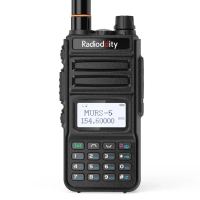

Use code WAVEGUIDE at checkout.

Those applications still have to stay within the technical rules governing MURS. The service has specific permitted emission types and channel-bandwidth limits. For example, the three 151 MHz channels have tighter occupied-bandwidth limits than the two 154 MHz channels.
For most users, the important takeaway is simpler: use equipment designed and certified for MURS rather than assuming that any programmable VHF radio can legally transmit there.
Being Able to Program MURS Does Not Make a Radio Legal
This is an important distinction.
A radio may be technically capable of transmitting on 151.820 MHz or another MURS frequency, but frequency capability alone does not make it authorized for MURS operation.
Purchase Guide
Wouxun KG-805M
Professional-Grade License-Free 2W MURS Handheld Radio Two-Pack
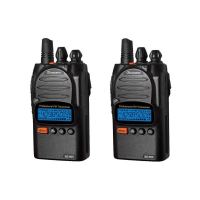


MURS transmitters are subject to FCC equipment-certification requirements. The current rules also generally prevent a new MURS transmitter certification from covering operation under MURS and another FCC service at the same time, other than Part 15 operation.
So a generic programmable radio or an amateur-radio handheld should not automatically be assumed legal for MURS just because its frequency range includes the five MURS channels.
Look for equipment specifically authorized for MURS use.
Where MURS Fits Beside FRS and GMRS
FRS emphasizes straightforward UHF handheld communication using highly standardized consumer equipment.
GMRS also uses UHF, but requires an individual license and supports capabilities such as higher-power equipment and repeaters.
MURS instead provides five VHF channels, a 2-watt transmitter limit, no repeaters, and the ability to use compliant fixed or external-antenna installations.
None is simply a replacement for the others. They operate under different technical rules and are suited to different types of radio systems. For someone who wants relatively simple, direct VHF communication without applying for an individual radio license, MURS is one of the options worth knowing about.
Simple, Useful and Often Overlooked
MURS is a small radio service: five channels, a 2-watt limit and no repeaters. But that does not mean it is limited to toy radios or casual conversations.
Its VHF frequencies, support for voice and data, business and personal uses, and ability to work with properly installed external antennas give MURS a distinct place among the FCC’s personal radio services.
The key is understanding what MURS actually allows rather than treating “license-free” as meaning unrestricted. Used within those rules, MURS can be a simple and practical communications option that many radio operators never seriously consider.