
The FCC ID printed on the back of a radio is easy to overlook. Behind it, however, is a testing and certification system intended to show that equipment meets the technical rules that apply before it reaches operators.
That system is changing.
On October 29, 2026, the Federal Communications Commission adopted new rules restricting where recognized testing, certification, and accreditation work for FCC equipment authorization can take place. The key transition date is December 1, 2028. After that point, covered work generally must occur in the United States or in a country that provides qualifying reciprocal recognition to U.S. testing and certification organizations.
For someone who already owns an authorized radio, this is not a reason to start replacing equipment. The bigger implications are upstream, affecting how future radios prove that they comply with FCC requirements before entering the U.S. market.
What FCC Certification Actually Means
FCC equipment authorization is separate from an operator license.
An operator license, when one is required, gives a person or station authority to operate under a particular radio service. Equipment authorization addresses the device itself and whether it complies with the FCC rules applicable to that equipment.
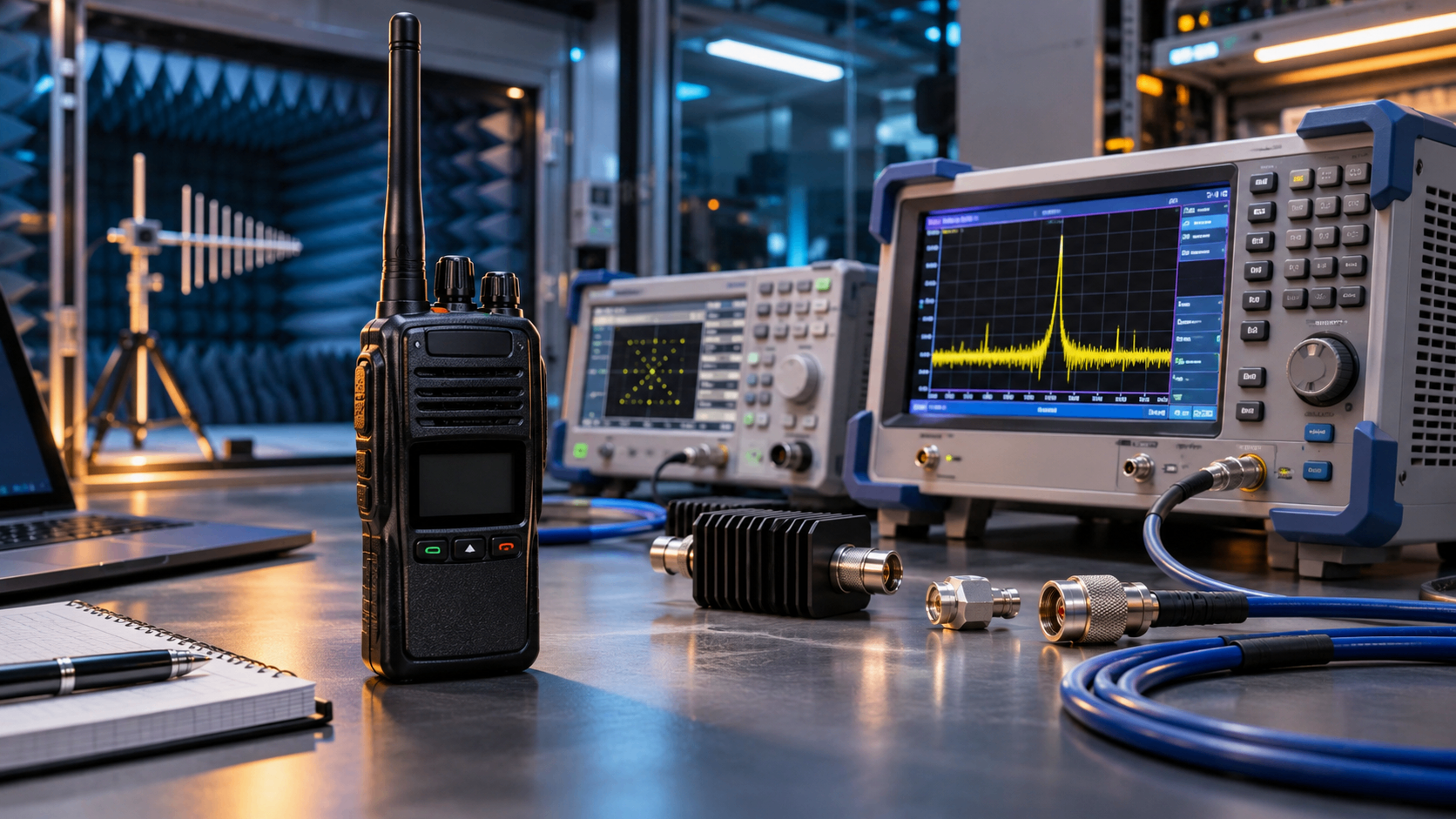
For equipment subject to the certification process, recognized test laboratories collect measurements and prepare technical reports demonstrating compliance. Telecommunications Certification Bodies, usually called TCBs, review certification applications and supporting information and make certification decisions under authority recognized by the FCC. The FCC describes this system as one way it controls the interference potential of radio-frequency equipment and verifies compliance with other applicable technical requirements.
Depending on the type of radio and the rules governing it, testing can examine characteristics such as transmitter power, occupied bandwidth, frequency stability, unwanted or spurious emissions, and applicable RF-exposure requirements.
Not every radio service treats equipment authorization the same way. Amateur Radio equipment, for example, operates under a different regulatory framework from many radios used in FCC Part 95 services. So an FCC ID should not be viewed as a universal requirement for every transmitter.
But where certification is required, the test results behind that authorization matter.
What the FCC Is Changing
The latest FCC action does not primarily change how many watts a transmitter may produce, how wide its signal may be, or the emission limits that a particular radio must meet.
Instead, it changes who can perform the recognized work used to establish that compliance and where that work can occur
Under the new framework, the FCC will limit recognition to qualifying test laboratories, TCBs, and laboratory accreditation bodies in the United States or in what the Commission calls a Reciprocal Economy. Broadly, that means an economy covered by a Mutual Recognition Agreement or another qualifying government-to-government arrangement that provides reciprocal treatment for U.S. conformity-assessment organizations.
The location requirement also reaches the substantive work itself. A recognized organization cannot simply maintain an eligible address while having core FCC testing or certification work performed from a non-reciprocal economy.
The FCC has pointed to several reasons for the change, including concerns about testing integrity and oversight, the concentration of equipment testing in non-reciprocal economies, and a desire for reciprocal treatment of U.S. testing organizations. The Commission has also taken separate enforcement actions against laboratories over inaccurate or falsified testing and previously adopted restrictions involving laboratories tied to prohibited entities.
What This Means for Radios You Already Own
For most radio operators, this is the most important part:
The new geographic testing rules do not automatically invalidate equipment that already has a legitimate FCC authorization.
The Commission’s transition framework preserves existing equipment grants. It also applies the new restriction to equipment-authorization applications received on or after December 1, 2028, rather than retroactively requiring previously authorized devices to be tested again simply because of where their original testing occurred.
So if you own a properly authorized GMRS handheld, commercial mobile radio, Part 95 device, or another piece of certificated equipment, the fact that its original testing may have occurred in a laboratory affected by the future rule does not, by itself, make that radio illegal.
There is an important distinction, however. An equipment authorization does not give an operator permission to use a radio however they want. Service-specific operating rules still apply. Frequency privileges, power limits, licensing requirements, permissible modifications, and equipment requirements depend on the radio service involved.
In other words, the FCC’s new test-lab rule does not erase existing authorizations—but neither does an existing FCC ID override the operating rules for a particular service.
How This Could Affect Future Radios
The greater impact may become visible when manufacturers develop their next generation of equipment.
A manufacturer that currently relies on a laboratory in a non-reciprocal economy may need to move FCC-related testing to another facility before submitting future certification applications after the cutoff. Certification bodies and accreditation organizations are subject to related geographic restrictions as well.
That could change the logistics of bringing a new radio to the U.S. market.
Manufacturers may have to establish relationships with different laboratories, move samples between countries, reserve testing capacity elsewhere, or reorganize parts of their certification process. For low-volume radios or inexpensive products, those changes could also become another factor manufacturers consider when deciding which models to certify for U.S. sale.
What operators should not assume is that the rule automatically means radios will become dramatically more expensive, that imported radios will disappear, or that equipment manufactured in a non-reciprocal country will automatically be prohibited.
The rule is primarily about where qualifying FCC testing and certification work occurs, not simply where the radio itself is manufactured.
That distinction matters. A radio built overseas may still be eligible for U.S. equipment authorization if the applicable requirements are satisfied through qualifying testing and certification channels.
For buyers, any effects on pricing, product selection, or launch timing will depend on how manufacturers adapt over the transition period.
Why Operators Should Care About the Testing Behind an FCC ID
Most radio problems are obvious. A weak receiver is frustrating. Poor audio can be heard immediately. A transmitter that will not produce rated power can usually be detected with basic test equipment.
Other problems are much harder for an operator to see.
A transmitter can appear to work normally on its intended frequency while producing excessive energy elsewhere. It may have problematic harmonics, spurious emissions, inadequate frequency stability, or other characteristics that require specialized equipment to measure properly.
That is one reason equipment testing exists.
A clean-looking signal on the display and a successful contact several miles away do not prove that a transmitter complies with every technical requirement that applies to it.
The laboratory work behind equipment authorization is therefore more than paperwork. When certification is required, it is part of the process used to demonstrate that the transmitter behaves appropriately not only on the frequency where the operator intends to transmit, but also in ways the operator may never notice during normal use.
That makes the integrity of the testing system relevant even to operators who never set foot inside an RF compliance laboratory.