
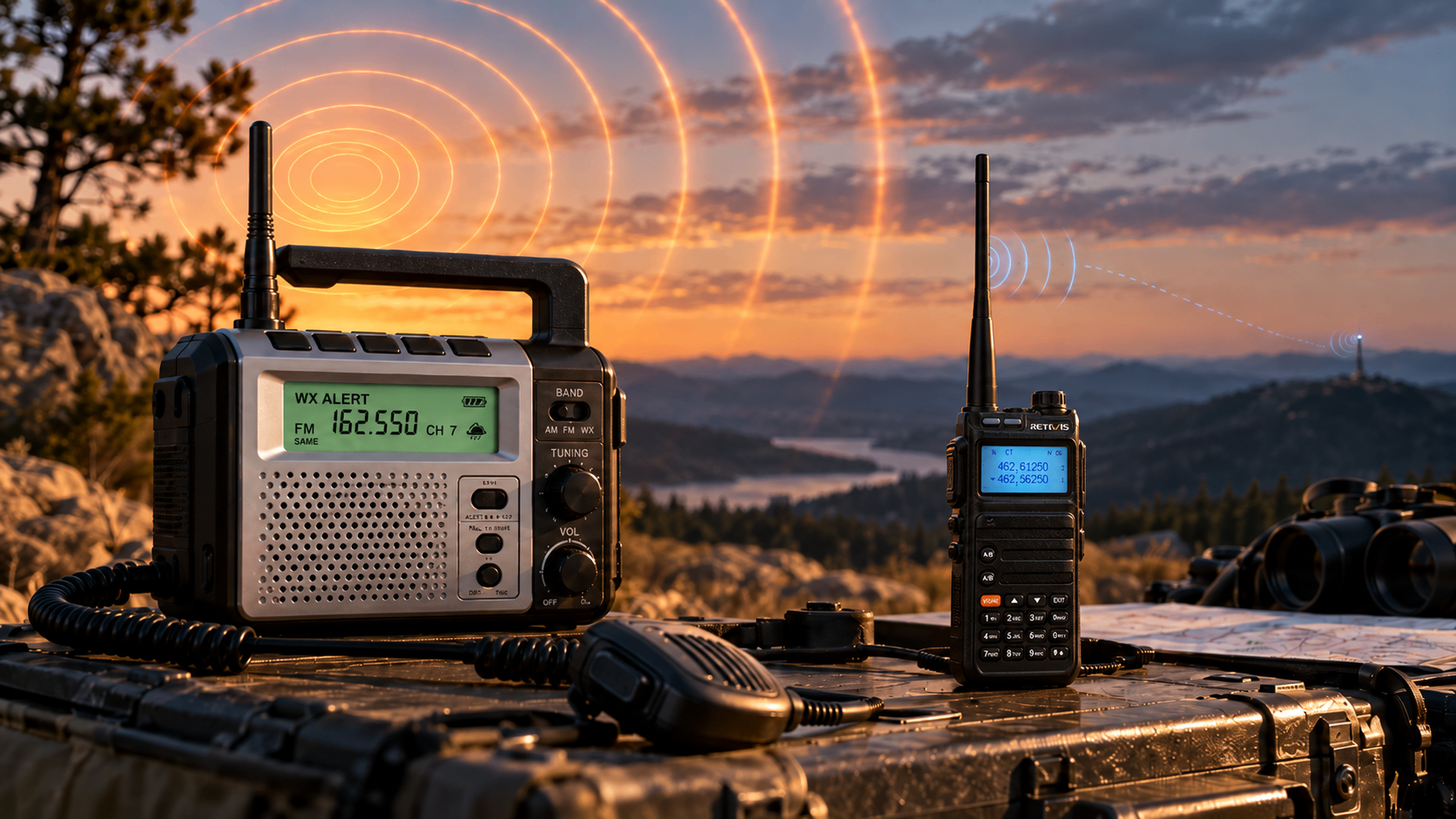
You are listening to a weak station that is coming through clearly. Then someone nearby keys another radio on a different frequency, and the station you were listening to suddenly fades or disappears.
As soon as the nearby transmitter stops, reception returns.
The second radio may not be transmitting on your receive frequency at all. Instead, the strong signal may be degrading your receiver’s ability to hear weak signals—a problem commonly called desensitization, or desense.
Desense can affect handhelds, mobile radios, base stations, repeaters, and larger communications systems. It also highlights an important point about receiver performance: sensitivity alone does not tell you how well a radio will behave around strong signals.
What Desense Is and What Happens Inside the Receiver
Desense is a reduction in a receiver’s ability to recover a weak desired signal when strong unwanted RF energy is present. The distant signal may still be reaching your antenna at essentially the same strength. What changes is the receiver’s ability to process it.
A useful analogy is trying to hear someone speaking quietly while a much louder sound is occurring nearby. The quiet person has not stopped talking, but the louder sound makes them much harder to hear.
A receiver faces a similar problem.
Inside the radio, the front end and following stages must handle both very weak wanted signals and much stronger unwanted ones. If a large off-frequency signal is strong enough, it can push parts of the receiver outside their ideal operating range.
One possible result is gain compression or overload. The receiver can no longer provide the same effective gain to the weak signal, so that signal becomes harder to recover.



In some receiver designs, automatic gain control, or AGC, can contribute to a similar effect. If a strong unwanted signal influences the circuitry that controls receiver gain, the radio may reduce its gain and make the much weaker desired signal harder to hear. This depends heavily on receiver architecture, filtering, and where the gain-control system operates.
Another strong-signal limitation is reciprocal mixing. A receiver’s local oscillator produces a small amount of phase noise around its intended frequency. When a very strong unwanted signal enters the receiver, that signal can mix with the oscillator’s phase noise and raise the effective noise floor inside the receive passband. The weak signal may then be masked by noise even though the receiver is not simply losing gain.
These mechanisms are different, but the operator may see the same practical result: A strong signal appears, and a weak signal becomes difficult or impossible to hear.
Why Nearby Transmitters Cause Problems
Distance can create an enormous difference in signal strength.
Suppose your receiver is listening to a handheld several miles away. By the time that signal reaches your antenna, it may be extremely weak. Now place another five-watt handheld only a few feet away and transmit.
Even though that nearby transmitter is on another frequency, the signal reaching your receiving antenna can be vastly stronger than the distant station you are trying to hear.
This is one reason desense commonly appears when multiple radios are used close together.
Typical examples include:
- two handheld radios used within a few feet of one another
- multiple radios installed in the same vehicle
- several stations operating from an event or emergency communications site
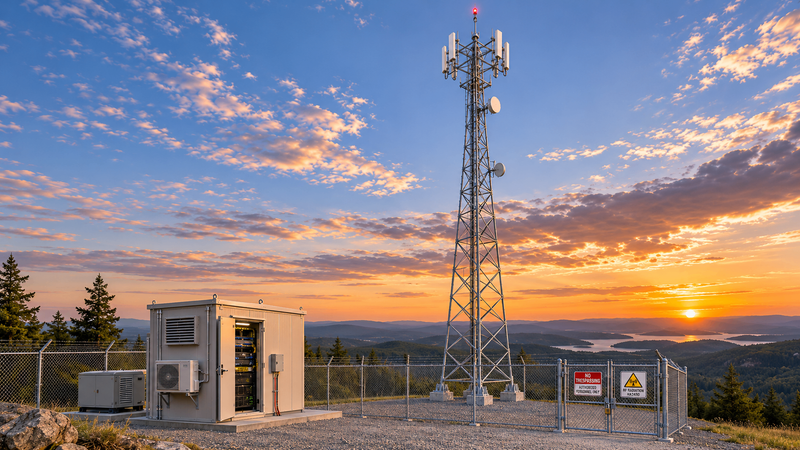
- multiple antennas mounted on the same tower or rooftop
- repeater systems that transmit and receive at the same site
The transmitter itself can also contribute to the problem.
Real transmitters do not produce one perfectly clean carrier and nothing else. They can also produce small amounts of broadband noise, phase noise, harmonics, and other unwanted energy.
If the transmitter is extremely close to the receiving system, even relatively low-level unwanted energy can matter. Some of it may fall directly inside the frequency range the other radio is trying to receive and raise the noise floor.
That is an important distinction: receiver overload and reciprocal mixing are limitations inside the receiving system, while transmitter broadband or phase noise can place unwanted RF energy directly into the receive channel.
Frequency separation helps, but it is only part of the picture. Transmitter power, physical separation, antenna isolation, filtering, transmitter cleanliness, and receiver design all influence whether desense occurs.
How to Recognize Desense and How It Differs From Intermod
The classic symptom is straightforward.
You are receiving a weak station. Another nearby transmitter keys up. The weak station suddenly becomes unreadable. When the transmitter unkeys, reception returns.
Other cases are less obvious.
A receiver may appear to have much shorter range whenever another transmitter is active. A mobile radio might normally receive a repeater clearly but struggle when another radio in the same vehicle transmits. In some cases, the apparent noise floor rises. In others, the desired signal simply fades or disappears.
You may also notice that two receivers behave very differently under the same conditions. One continues working while another becomes almost unusable. That difference is one reason receiver sensitivity and strong-signal performance are not the same thing.
Desense is also commonly confused with intermodulation, but they are not identical. With desense, strong RF makes the receiver less capable of recovering the weak signal you want. With intermodulation, signals interact in nonlinear circuitry and create additional unwanted signals at new frequencies. An intermodulation product can therefore appear on a frequency where no transmitter is intentionally operating.
A crowded RF environment can produce both problems at once.
A useful shorthand is: Desense hides a signal that is already there. Intermodulation can create an unwanted signal somewhere else.
How to Reduce Desense
There is no single fix because the best solution depends on how the unwanted RF is reaching or affecting the receiver.
Increase antenna separation. Moving transmitting and receiving antennas farther apart reduces the amount of transmitter energy coupled into the receiver.
Improve antenna isolation. Vertical or horizontal separation, antenna radiation patterns, polarization, mounting location, and surrounding structures can all change how strongly two antennas couple to each other.
Increase frequency separation when possible. Greater separation can make unwanted signals easier for receiver and external filters to reject. However, a sufficiently strong nearby signal can still cause problems even when it is far away in frequency.
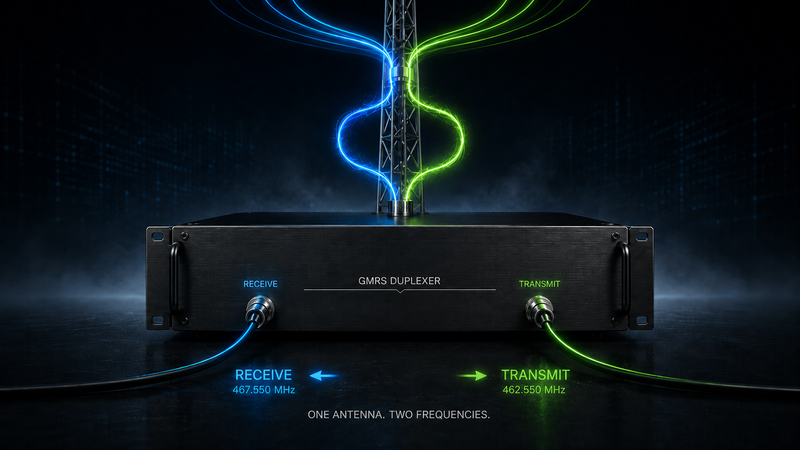
Use appropriate filtering. Band-pass filters, notch filters, cavity filters, duplexers, and other filtering can reduce unwanted RF before it reaches the receiver or reduce unwanted energy leaving a transmitter.
Purchase Guide
BridgeCom BDR-4550
UHF Analog and DMR Amateur Radio Repeater with 50W Output and IP Network Integration
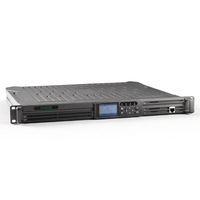

Repeaters are a good example. A repeater may transmit a relatively powerful signal while trying to receive a much weaker signal at the same site, so isolation and filtering are critical.
Reduce unnecessary receiver gain. More gain is not always better. Disabling a preamplifier, reducing RF gain, or adding attenuation can sometimes improve reception if a strong signal is overloading the receiver.
The desired signal becomes weaker too, but reducing all incoming signals can allow an overloaded receiver to return to a more linear operating condition. If adding attenuation unexpectedly improves reception, that is a useful clue that strong-signal performance may be part of the problem.
Use equipment with better strong-signal performance. Two radios can have similar weak-signal sensitivity specifications yet behave very differently near strong transmitters. Front-end filtering, linearity, oscillator phase noise, dynamic range, and gain-control design all affect how well a receiver performs in a crowded RF environment.
The Bigger Lesson About Receiver Performance
Receiver sensitivity answers one important question: How weak a signal can this radio hear?
But real-world operation raises another: Can it still hear that weak signal when much stronger signals are nearby?
Desense demonstrates why those are different questions.
A receiver can perform very well in a quiet RF environment and struggle badly when another transmitter operates nearby. Another receiver with better strong-signal performance may continue working under the same conditions.
Understanding desense helps explain why antenna placement matters, why repeater systems need isolation and filtering, why transmitter cleanliness matters, and why sensitivity alone cannot describe receiver quality.
Sometimes the station you were listening to never went away.
The RF environment simply became more than the receiver could handle.