
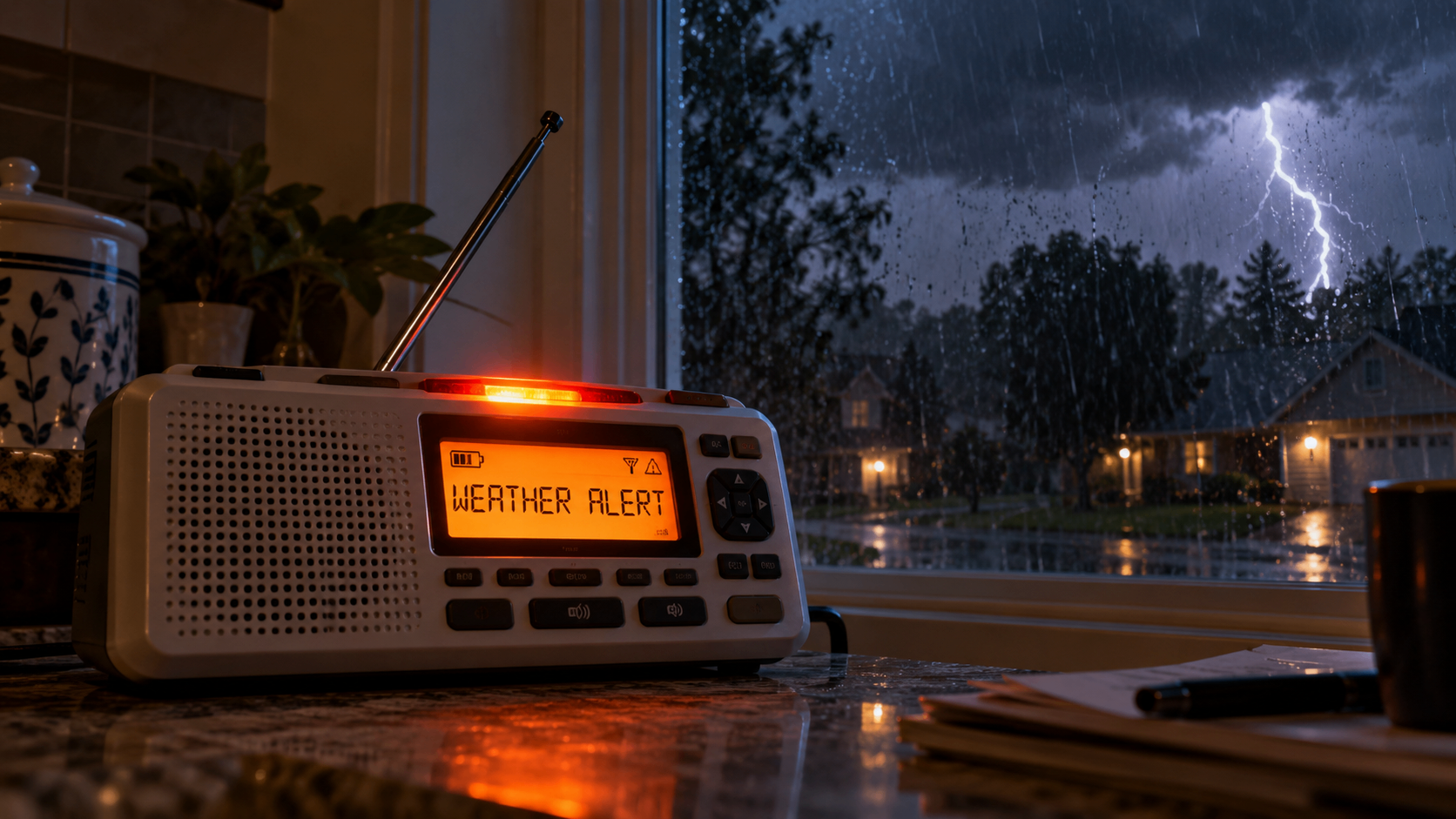
A NOAA Weather Radio can sit quietly on a shelf for hours and then suddenly come to life with an alarm, followed by a tornado warning, flash flood warning, or another urgent message.
To the listener, it can seem almost automatic. Somewhere, dangerous weather develops—and the radio somehow knows when to make noise. But there is a well-defined radio system behind that alert.
NOAA Weather Radio All Hazards, usually abbreviated NWR, is a nationwide network of more than 1,000 transmitters carrying official National Weather Service information around the clock. The broadcasts use seven VHF frequencies between 162.400 and 162.550 MHz.
Most of the time, those transmitters carry routine forecasts, observations, and weather information. When an alert is issued, additional signaling tells compatible receivers what is happening and whether they should activate.
Here is how it works.
NOAA Weather Radio Is Always Broadcasting
Unlike a radio system where a channel remains silent until someone needs to transmit, NOAA Weather Radio normally operates continuously. Tune to your local NWR station and you will typically hear a repeating cycle of forecasts, current conditions, weather summaries, and other information.
NOAA Weather Radio uses seven frequencies: 162.400 MHz 162.425 MHz 162.450 MHz 162.475 MHz 162.500 MHz 162.525 MHz 162.550 MHz
If you are not sure which NOAA Weather Radio transmitter serves your area, the National Weather Service offers a station search tool that can help you find nearby stations and verify coverage.
These frequencies are outside the standard 88–108 MHz FM broadcast band, so an ordinary FM receiver cannot tune them. Dedicated weather radios can, as can many scanners, marine radios, communications receivers, and some amateur, GMRS, CB, and other radios with weather-band reception.
But simply being able to listen to NOAA Weather Radio does not necessarily mean a radio can automatically alert you. For that, the receiver needs additional alerting capability.
Step 1: The National Weather Service Issues an Alert
Suppose the National Weather Service issues a tornado warning. Along with the spoken warning that listeners eventually hear, NOAA Weather Radio can transmit machine-readable information describing the alert.
That system is called SAME, or Specific Area Message Encoding. SAME tells compatible receivers several useful things, including the type of event, the geographic area affected, when the message was issued, and how long it remains valid.
Instead of activating for every alert carried by the transmitter, a SAME-equipped receiver can compare that digital information with the locations and alert types it has been programmed to monitor.
Step 2: The Transmitter Sends the SAME Header
Immediately before the warning message, NOAA Weather Radio sends a short burst of digital data. To a person listening directly, it sounds somewhat like a brief burst of harsh static.
Inside that data is the SAME header. The header includes an event code identifying the type of message and one or more location codes identifying where the alert applies.
For example, the event code TOR identifies a Tornado Warning, while SVR identifies a Severe Thunderstorm Warning. A geographic SAME code uses six digits in a format commonly written as PSSCCC. The SS portion identifies the state or territory and CCC identifies the county or equivalent geographic area. For most users, the first digit, P, is zero, meaning the entire county or an unspecified portion of it. If you want to look up the SAME code for your area or learn more about how SAME works, the National Weather Service’s NWR SAME reference page includes codes for states, counties, territories, and alert message types.
NWS can also use non-zero P digits for Partial County Alerting, dividing selected counties into smaller warning areas. This is not used everywhere; NWS primarily implements it where the geography or size of a county makes more targeted alerting useful. Compatible SAME receivers can be programmed with those partial-county codes where the service is available.
When a SAME-capable radio receives a header, it compares the transmitted information with its programmed settings. If the location and event meet the receiver’s criteria, the radio can activate. That is why two radios monitoring the same NOAA transmitter do not necessarily have to sound for every identical alert.
The SAME Header Is Actually Sent Three Times
There is another detail that is easy to miss if you only hear the brief digital noise. NOAA Weather Radio does not transmit the SAME header just once.
The SAME preamble and header are transmitted three consecutive times, with a brief pause between each coded burst. Repeating the data gives receiving equipment multiple opportunities to correctly decode the message despite noise or other reception problems.
So the beginning of an alert is more accurately represented as: SAME header ×3 → attention tone when used → voice message
The listener usually perceives those three data bursts simply as the characteristic digital noise preceding an alert.
Step 3: The Radio Wakes Up
Many dedicated weather radios spend most of their lives appearing to do nothing. The speaker may be silent, but the receiver is still monitoring the selected NOAA Weather Radio frequency.
When the correct SAME information arrives, a compatible receiver can leave standby mode and respond according to its design. That might mean sounding an alarm, illuminating warning lights, displaying an event type, or opening the speaker so the warning can be heard.
There is also an older alerting method that does not provide SAME’s geographic information: the 1050 Hz Warning Alarm Tone.
A receiver designed around tone alerting can activate when it detects that audio tone. It does not need to decode county-specific SAME information to recognize the alert.
That creates an important distinction: SAME provides machine-readable information about the event and where it applies. The 1050 Hz tone serves as an attention signal.
Step 4: The Attention Tone Sounds
When used for an alert, the familiar steady NOAA Weather Radio warning tone follows the SAME data and precedes the spoken message. Its frequency is 1050 Hz.
If you are listening directly to the weather channel during an alert, this is the long, steady tone most people associate with NOAA Weather Radio warnings.
The attention tone is not transmitted for every routine forecast or weather update. Alert signaling is used for messages that meet NWS alerting criteria rather than every change to the regular broadcast.
For SAME-equipped radios, the important decision may already have occurred before the 1050 Hz tone begins: the radio has received the digital header and determined that the alert matches its programmed area.
Step 5: The Voice Warning Follows
After the alert signaling, the actual warning message is transmitted over the same VHF-FM channel.
This is the part intended for the listener: what is happening, where the threat is located, how long the warning is in effect, and any recommended protective actions. Nothing separate has to connect to the radio.
The digital signaling, attention tone, and spoken warning all travel through the same NOAA Weather Radio broadcast that the receiver was already monitoring.
Step 6: The Radio Receives the End-of-Message Signal
Once the spoken alert finishes, NOAA Weather Radio sends another digital sequence called the End of Message, or EOM. Like the SAME header at the beginning, the EOM sequence is transmitted three times, with brief pauses between the bursts. Compatible receivers can use this signaling to recognize that the alert has ended. Routine NOAA Weather Radio programming can then continue.
For a typical alert that uses the attention tone, the complete over-the-air sequence can therefore be simplified as: SAME header ×3 → 1050 Hz attention tone → voice warning → EOM ×3
The attention tone is not required for every SAME message, so the exact sequence can vary depending on the event.
So what do these alerts sound like? This video from Tim Vasquez’s Forecast Lab demonstrates the decoding of a NOAA Weather Radio SAME alert and offers a helpful real-world example of what the digital alert sequence sounds like over the air.
Hearing NOAA Is Not the Same as Having Weather Alert
This distinction matters when looking at radios advertised with terms such as NOAA, WX, Weather Band, or Weather Alert. A radio might tune 162.550 MHz and let you manually listen to your local forecast but provide no automatic warning function at all. Another radio might monitor a weather frequency and react to an alert tone but offer no county-selective SAME decoding.
A dedicated SAME-capable weather radio can go further by reading the digital message and deciding whether the warning applies to a programmed geographic area.
In practical terms, there are three different capabilities worth separating:
- Weather-band reception means the radio can tune and receive NOAA Weather Radio.
- Weather alert capability means the receiver can automatically respond to an alerting signal.
- SAME capability means the receiver can decode the digital alert information and use geographic and event information when deciding whether to activate.
A product description saying a radio has “NOAA weather” does not necessarily mean it includes all three.
Why Reception Still Matters
Every part of this system depends on receiving a usable RF signal.
NWS describes NOAA Weather Radio transmitters as generally providing coverage out to roughly 40 miles, but that is not a guaranteed radius. Terrain, transmitter power and location, buildings, receiver sensitivity, antenna placement, and propagation conditions can all change the usable coverage considerably.
A weak signal might occasionally provide understandable voice audio while still being unreliable enough to cause problems decoding digital alert data.
That leads to an important rule for anyone relying on weather-alert reception: Being able to hear NOAA Weather Radio sometimes is not the same as having reliable alert reception.
Moving the receiver nearer a window, changing its orientation, extending its antenna, or using an appropriate external antenna can sometimes make a major difference.
A One-Way Broadcast That Lets the Radio Decide
One of the most interesting things about NOAA Weather Radio is what it does not require. Your radio does not tell NOAA where you are.
It does not register with the transmitter. It does not transmit anything back. And the NOAA transmitter does not individually address your receiver.
Instead, the National Weather Service sends the warning to every receiver within range. SAME adds enough digital information for compatible radios to determine whether the alert matches the geographic areas and events they have been configured to monitor. That combination—a continuously available VHF broadcast plus a small amount of digital alert data—is what allows a weather radio to sit silently for hours and then suddenly know when it is time to make noise.