
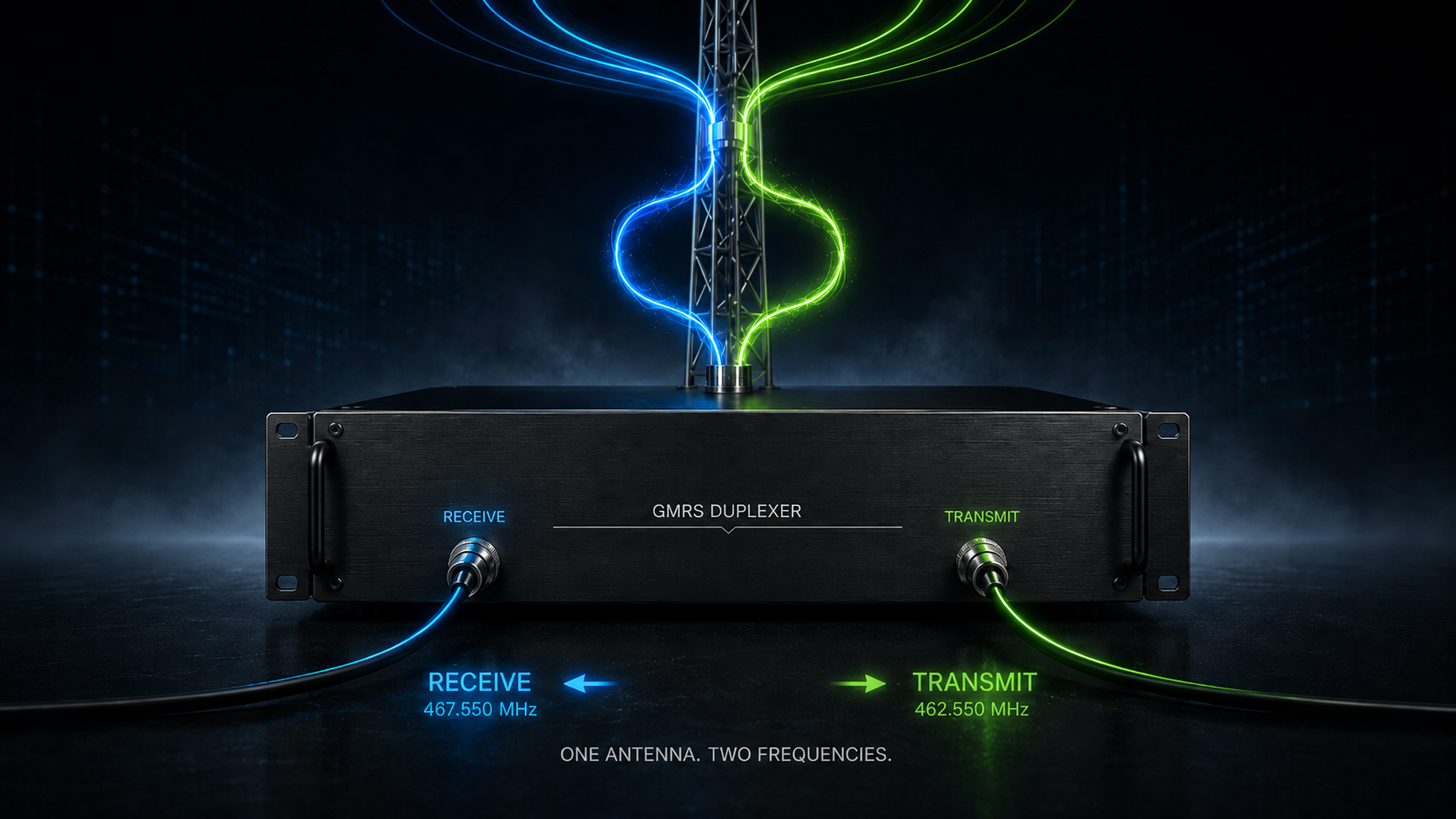
If you have spent much time using GMRS repeaters, the basic process is probably familiar. Your radio transmits to the repeater on its input frequency, the repeater receives that signal, and then retransmits it on its output frequency. On GMRS, repeater operation uses paired channels in the 467 MHz and 462 MHz portions of the band.
What is less obvious is what happens inside the repeater site.
A repeater may be trying to receive a very weak signal from a handheld several miles away while, at essentially the same time, its transmitter is producing tens of watts of RF power. In many installations, both jobs have to happen through the same antenna.
That is an enormous difference in signal levels. It is a little like trying to hear someone whisper while standing beside a loudspeaker. Simply connecting the transmitter and receiver to the same antenna would allow far too much transmitter energy into the receiver.
That is where the duplexer comes in.
What is a Duplexer?
A duplexer is a set of carefully tuned RF filters installed between the repeater’s transmitter, receiver, and antenna. It allows the transmitter and receiver to share one antenna while providing substantial isolation between them.
Conceptually, the paths look like this:
One important distinction: the duplexer does not create the repeater’s frequency offset. The transmitter and receiver are already operating on separate frequencies. The duplexer’s job is to keep those closely spaced frequencies sufficiently separated inside the antenna system.
What the Duplexer Is Actually Doing
A duplexer has two related jobs.
-
On the transmit side, it lets the high-power signal pass cleanly out to the antenna while filtering out stray background noise. Transmitters don’t just output power on their main channel—they also emit low-level electrical noise across neighboring frequencies. The transmit filter suppresses this broadband noise on the receive frequency so it doesn’t leak across and mask weak incoming signals.
-
On the receive side, it lets the tiny incoming signal pass straight to the receiver while completely blocking the repeater’s own powerful transmit signal, keeping the receiver’s front end from being overwhelmed and deafened (desensed).
This introduces three terms worth knowing when you start shopping for duplexers.
Pass frequency describes a frequency the filter is intended to pass with relatively little loss. Reject, or notch, refers to a frequency the filter is designed to heavily suppress. Isolation, usually specified in decibels, describes how effectively the transmit and receive paths are separated. Commercial duplex systems can require many tens of decibels of isolation between those paths.
This is also why you cannot substitute an ordinary RF splitter or T-connector. A splitter can divide or combine RF paths, but it does not provide the selective filtering needed to keep a powerful transmitter from overwhelming a sensitive receiver.
When that isolation is inadequate, the result can be receiver desensitization, usually shortened to desense. The repeater’s own transmitter raises the effective noise or interference seen by the receiver, reducing its ability to hear weak stations.
To the user, this can produce a confusing symptom: you can hear the repeater much farther away than the repeater can hear you.
That does not automatically mean the duplexer is at fault. Antenna systems, feedline, connectors, local RF noise and the user’s radio all affect repeater performance. But poor duplexer isolation or incorrect tuning are important possibilities when receive performance deteriorates while the transmitter is active. Isolation between transmit and receive paths is a fundamental concern in duplex radio systems because unwanted energy reaching the receiver can degrade its usable sensitivity.
Isolation Comes With a Cost: Insertion Loss
Filtering RF isn’t completely free.
As the desired signal passes through a duplexer, some of its energy is lost. This is known as insertion loss, and it applies in both directions.
On transmit, insertion loss means the power leaving the repeater transmitter will be somewhat higher than the power that actually reaches the feedline and antenna. On receive, it means an already weak incoming signal becomes slightly weaker before arriving at the receiver. Duplexer and filter insertion loss is therefore part of the total RF-system loss that should be considered when evaluating a repeater installation.
The engineering objective is a balance: provide enough isolation between transmitter and receiver without unnecessarily attenuating the signals you actually want.
This is one reason repeater performance cannot be judged by transmitter wattage alone. A 50-watt transmitter connected through a poorly configured RF system may produce a less useful repeater than a lower-powered system with a well-designed antenna, feedline and duplexer.
Mobile Notch vs. Full-Size BPBR Cavity Duplexers
Start shopping for a duplexer and you will quickly discover that they range from compact units that can fit into portable repeater cases to large sets of metal cavities that may take up a significant portion of a rack.
Those products are not necessarily intended to solve the same problem.
Compact duplexers (often referred to as “flat-pack” or “mobile notch” duplexers) are attractive when space, weight, and cost matter. They rely on small helical or coaxial resonators tuned to act exclusively as notch (band-reject) filters.
- How They Work: A mobile notch duplexer does not filter out off-target RF frequencies across the spectrum; it creates two narrow “notches” designed specifically to keep your repeater’s transmitter frequency out of its receiver, and vice versa.
- The Tradeoffs: Because they offer virtually no broad bandpass filtering, everything outside those two narrow notch frequencies passes straight through. Strong off-frequency signals—such as nearby paging transmitters, commercial broadcasts, or adjacent repeaters—will pass directly into your receiver and cause receiver desensitization (desense) or intermodulation. Additionally, their smaller physical volume limits power handling (typically capped at 30 to 50 Watts) and thermal stability, meaning high duty-cycle transmissions can cause the notches to drift as the unit heats up.
Full-size cavity duplexers, most commonly using a Bandpass/Band-Reject (BPBR) architecture, are the standard at permanent, shared repeater sites.
- How They Work: BPBR cavities combine bandpass and notch filtering inside large, high-Q resonant chambers. Instead of just acting as a simple filter that passes a wide range or notches a single point, a BPBR cavity does both at once: it creates a wide “pass” window for your operating frequency, with a steep, sharp “reject” notch carved directly beside it to eliminate the paired transmit or receive frequency 5 MHz away.
- The Performance Edge: By forming a passband window around your assigned operating frequencies while notching out unwanted energy, a BPBR duplexer rejects both receiver-side desense and external off-frequency interference. Their large physical volume uses low-expansion materials (like Invar rods) to maintain precise tuning across wide temperature shifts, and they can comfortably process hundreds of Watts of continuous transmit power without drift.
| Feature | Compact Mobile Notch Duplexer | Full-Size BPBR Cavity Duplexer |
|---|---|---|
| Primary Function | Sharp notch rejection at fixed TX/RX frequencies only. | Broad bandpass filtering paired with deep notch rejection. |
| Isolation & Noise Protection | Protects TX/RX from each other; leaves receiver vulnerable to nearby external RF. | Protects against TX/RX bleed and blocks off-frequency site noise/intermod. |
| Power & Thermal Limits | Lower power (30–50W typical); susceptible to heat drift during heavy duty cycles. | High power handling (100W–350W+); thermally stable under continuous duty. |
| Physical Profile | Fits in standard mobile radios, portable cases, or 1U/2U shelves. | Bulky 4-to-6 cavity array requiring 3U–6U+ of rack space. |
The important question is therefore not simply, “Which duplexer is better?” It is, “What level of isolation and loss does my repeater installation require?”
A portable repeater being deployed for a local event presents a different RF problem from a high-elevation repeater expected to hear weak handhelds while continuously operating from a permanent site. The local RF environment matters too. A quiet residential location is very different from a communications site containing numerous transmitters and antennas.
A Duplexer Has to Be Tuned
Perhaps the most important thing for a first-time repeater owner to understand is that a duplexer isn’t simply a box labeled “UHF” that you connect between the repeater and antenna.
Its filters need to be adjusted for the frequencies the repeater will actually use.
The mechanical cavities and resonant elements inside the duplexer are adjusted so that the desired frequencies follow the correct paths while the unwanted frequency is heavily rejected. How well that adjustment is performed directly affects both isolation and insertion loss.
That means frequency range and tuning are two different things.
A duplexer advertised as operating in the 450–470 MHz range may be suitable hardware for GMRS, for example, but that does not necessarily mean it is already tuned for your particular repeater pair.
Proper alignment is normally verified using RF test equipment capable of showing how the duplexer behaves across the relevant frequencies. Depending on the equipment and procedure, technicians may use instruments such as a network analyzer or communications service monitor rather than trying to tune the cavities by ear or by looking only at whether the repeater appears to work.
For someone purchasing a first repeater, this distinction can prevent a lot of frustration: compatible with your frequencies does not necessarily mean tuned for your frequencies.
Should You Buy the Duplexer With the Repeater or Separately?
For a first installation, buying a repeater and duplexer as a configured package can make sense. A reputable seller may tune the duplexer for your requested frequency pair, supply the appropriate interconnecting cables, and test the combination before shipment.
That removes several variables from your first installation.
But don’t assume that every “repeater with duplexer” package provides the same level of performance. Find out what duplexer is included, whether it is actually tuned to your frequencies, and whether the seller provides measured results.
Buying the duplexer separately gives you more control. You can select one based on the needs of your site rather than simply accepting whatever was bundled with the repeater.
Useful specifications and questions include:
- Frequency range and supported frequency separation
- Transmit-to-receive isolation
- Insertion loss
- RF power handling
- Connector type
- Physical size and mounting requirements
- Whether tuning is included
- Whether measured test results are provided
Used cavity duplexers can also be attractive because high-quality commercial hardware can remain useful for many years. But a used duplexer should not be assumed to be correctly aligned for your system simply because it came from another UHF repeater. Plan on having its condition and tuning checked.
And don’t let maximum power handling dominate your buying decision. A duplexer capable of handling far more transmitter power than you intend to use is not necessarily the best-performing choice for your installation. Isolation, insertion loss and correct tuning are at least as important to the finished repeater system.
One of the best questions you can ask before buying is simple:
Is this duplexer tuned and tested for my exact repeater transmit and receive frequencies, or is it merely designed to operate in this frequency range?
That question can tell you considerably more than the word “GMRS” printed on a product listing.
The Component You Barely Notice When It Works
The repeater itself tends to get most of the attention. It has the receiver, transmitter, controls, display and power rating, so it naturally feels like the center of the system.
But a repeater using one antenna depends on the duplexer to make simultaneous transmitting and receiving practical. When the duplexer is properly selected and tuned, there is little reason for an operator to think about it. When it isn’t, even a good repeater connected to a good antenna can produce surprisingly poor results.
As you move from using repeaters to building your first one, it helps to stop thinking of the repeater as a single radio in a box.
It is an RF system made up of the transmitter, receiver, duplexer, feedline and antenna—and the duplexer is the component that allows those pieces to work together without the repeater shouting over its own ears.