
Digital voice opens a different side of VHF and UHF amateur radio. Instead of simply selecting a repeater frequency and PL tone, operators can connect through talkgroups, reflectors, rooms, and linked networks that bring together hams well beyond the coverage area of a single repeater.
But getting started raises an obvious question: Which digital voice mode should you choose?
DMR, D-STAR, System Fusion, and P25 can all carry digital voice, but they approach the job differently. Each has its own terminology, equipment choices, networking methods, and operating communities. There isn’t one system that is automatically best for every ham.
For most operators, the right choice comes down to four things: what is active locally, who you want to talk to, how much complexity you are comfortable with, and what equipment ecosystem appeals to you.
This discussion focuses specifically on digital voice. Modes such as FT8, JS8Call, RTTY, packet, and other forms of digital data are a different part of amateur radio.
Before Choosing a Mode, Look Around You
It can be tempting to start by comparing radios, modulation methods, or network features. A better first step is often much simpler: find out what people in your area are actually using.
Suppose the local club maintains an active System Fusion repeater and many of its members own compatible radios. In that situation, Fusion may offer considerably more day-to-day value than choosing another mode simply because it has a larger network somewhere else.
The same applies to DMR, D-STAR, and P25. A nearby repeater listed in a directory also doesn’t necessarily mean there is an active community behind it. Listen, check local club information, and ask nearby operators which repeaters and networks regularly see traffic.
A personal hotspot can change the equation. Hotspots use a low-power RF connection between your radio and a small Internet-connected device, allowing access to supported digital networks without relying on a nearby repeater. They can be particularly useful for operators who live outside the coverage area of the system they want to use.
Still, a hotspot and a local repeater serve somewhat different purposes. If local communication is important to you, the mode your nearby ham community actually uses deserves serious weight.
DMR: Lots of Options, With More to Learn
DMR, or Digital Mobile Radio, came into amateur radio from the commercial land-mobile world rather than being designed specifically for hams. Amateur operators have adapted it into a large ecosystem of repeaters, hotspots, talkgroups, and interconnected networks.
One of DMR’s defining technical features is two-slot TDMA, or Time Division Multiple Access. A DMR repeater divides a single 12.5 kHz radio channel into two alternating time slots. That allows the repeater to carry two independent conversations at the same time, with each user occupying one of the two time slots. In practical terms, one repeater frequency pair can support two simultaneous talk paths.
For the operator, though, the more noticeable difference is the way conversations are organized.
DMR uses talkgroups, which function as destinations for groups of users. A talkgroup might represent a state, region, club, special-interest community, or wide-area calling group. Networks such as BrandMeister provide large numbers of these talkgroups for amateur use.
That flexibility is one of DMR’s strengths, but it also creates its biggest hurdle for newcomers.
Programming a DMR radio may involve radio IDs, talkgroups, time slots, color codes, contacts, zones, and channels. Much of this information is normally assembled into a codeplug, essentially the programming configuration that tells the radio how and where to operate.
Once the concepts make sense, DMR can offer considerable flexibility. Getting to that point, however, generally requires more setup than programming a conventional analog FM repeater.
DMR may be a good fit if: you want access to a large digital community, like having many equipment choices, and don’t mind investing some time in programming and learning the system.
D-STAR: Built With Amateur Radio in Mind
D-STAR, short for Digital Smart Technologies for Amateur Radio, takes a different approach. Unlike DMR and P25, it was developed specifically for amateur-radio digital voice and data communication.
Callsigns are deeply integrated into the system. D-STAR transmissions can carry callsign information, and its network infrastructure can route communication through repeaters, gateways, and Internet-linked systems. Operators can also connect to reflectors, which allow multiple nodes and users to participate in shared conversations.
For operators accustomed to identifying everything by frequency, tone, or numeric ID, the callsign-oriented approach may initially feel unfamiliar. Once learned, however, it fits naturally into amateur radio’s existing identification system.
D-STAR also has a mature network infrastructure and has been in amateur use for many years. The bigger question for a new user is often local availability. D-STAR activity can be strong in one area and scarce in another.
Equipment choice is also more concentrated than with DMR, so operators considering D-STAR should look at both nearby infrastructure and the radios available to them before committing.
D-STAR may be a good fit if: you like the idea of a system designed specifically around amateur radio, prefer callsign-oriented operation, and have an active D-STAR repeater or community available to you.
System Fusion: A Familiar Path From Analog FM
System Fusion is Yaesu’s amateur digital-radio platform. Its digital side uses C4FM, short for Continuous 4-Level Frequency Shift Keying, a four-level FSK modulation scheme used to carry digital voice and data. In other words, System Fusion is the overall Yaesu radio ecosystem, while C4FM describes the modulation used for its digital RF signal.
One of System Fusion’s most useful characteristics is how closely conventional analog FM and digital operation can coexist within the same repeater ecosystem.
Compatible Fusion repeaters can be configured to recognize analog FM and C4FM digital signals. Features such as Yaesu’s Automatic Mode Select can allow a repeater to identify the incoming mode automatically, giving repeater groups flexibility when introducing digital operation without necessarily abandoning analog users.
For Internet-linked operation, Yaesu’s WIRES-X system connects compatible nodes and repeaters. Operators can connect to rooms, which provide gathering points for stations in different locations.
Compared with DMR, Fusion can feel less configuration-heavy to a newcomer. You don’t have the same combination of talkgroups, time slots, and color codes to manage just to understand basic operation.
The tradeoff is that System Fusion is closely associated with Yaesu hardware. If you’re already interested in a Yaesu handheld or mobile radio, that may not matter at all. If you prefer a broad choice of manufacturers, it is something to consider.
System Fusion may be a good fit if: you want a relatively approachable transition from analog FM to digital voice, particularly if Fusion repeaters and Yaesu users are already common in your area.
P25: A Different Kind of Ham Radio Niche
P25, or Project 25, has a very different background. Its standards were developed primarily for interoperable digital communications used by public-safety and other professional radio systems.
P25 includes more than one technical generation. Phase 1 uses FDMA and supports conventional as well as trunked systems, while Phase 2 uses two-slot TDMA for trunked operation. In amateur radio, however, P25 activity is overwhelmingly Phase 1 conventional—the familiar setup of a radio communicating directly or through a conventional repeater. Phase 2 trunking adds infrastructure and system complexity that generally provides little practical advantage for normal amateur repeater use.
That doesn’t prevent amateur operators from experimenting with P25. In fact, it can be particularly interesting to hams who enjoy commercial land-mobile equipment, repeater systems, and the technical side of professional radio.
You may encounter used commercial P25 handhelds and mobiles from manufacturers whose equipment was originally intended for government or public-safety users. That can be part of the appeal: some hams enjoy programming, maintaining, and repurposing professional-grade radios for amateur frequencies.
It can also make P25 a more specialized path.
Programming software and cables may be less straightforward to obtain or use, and amateur P25 activity is considerably more dependent on having an established local community or repeater system. For someone simply looking for an easy entry into networked digital voice, one of the other three systems will often present a more obvious path.
P25 may be a good fit if: you enjoy commercial-radio technology, like experimenting with professional equipment, or happen to live in an area with an established amateur P25 community.
Six Questions to Ask Before Buying
Rather than choosing based on the logo on the radio or a single feature comparison, answer these questions first:
- Which digital repeaters near me are actually active?
- What modes do the hams I want to communicate with use?
- Do I mainly want local repeater communication, or am I interested in wide-area networked conversations?
- How much programming and configuration am I willing to learn?
- Will I use a hotspot when a compatible repeater isn’t available?
- Do I already prefer or own radios from a particular manufacturer?
Those answers can make the decision considerably easier.
A Simple Way to Think About Your Choices
If you’re still sorting through the options, think of the four systems this way:
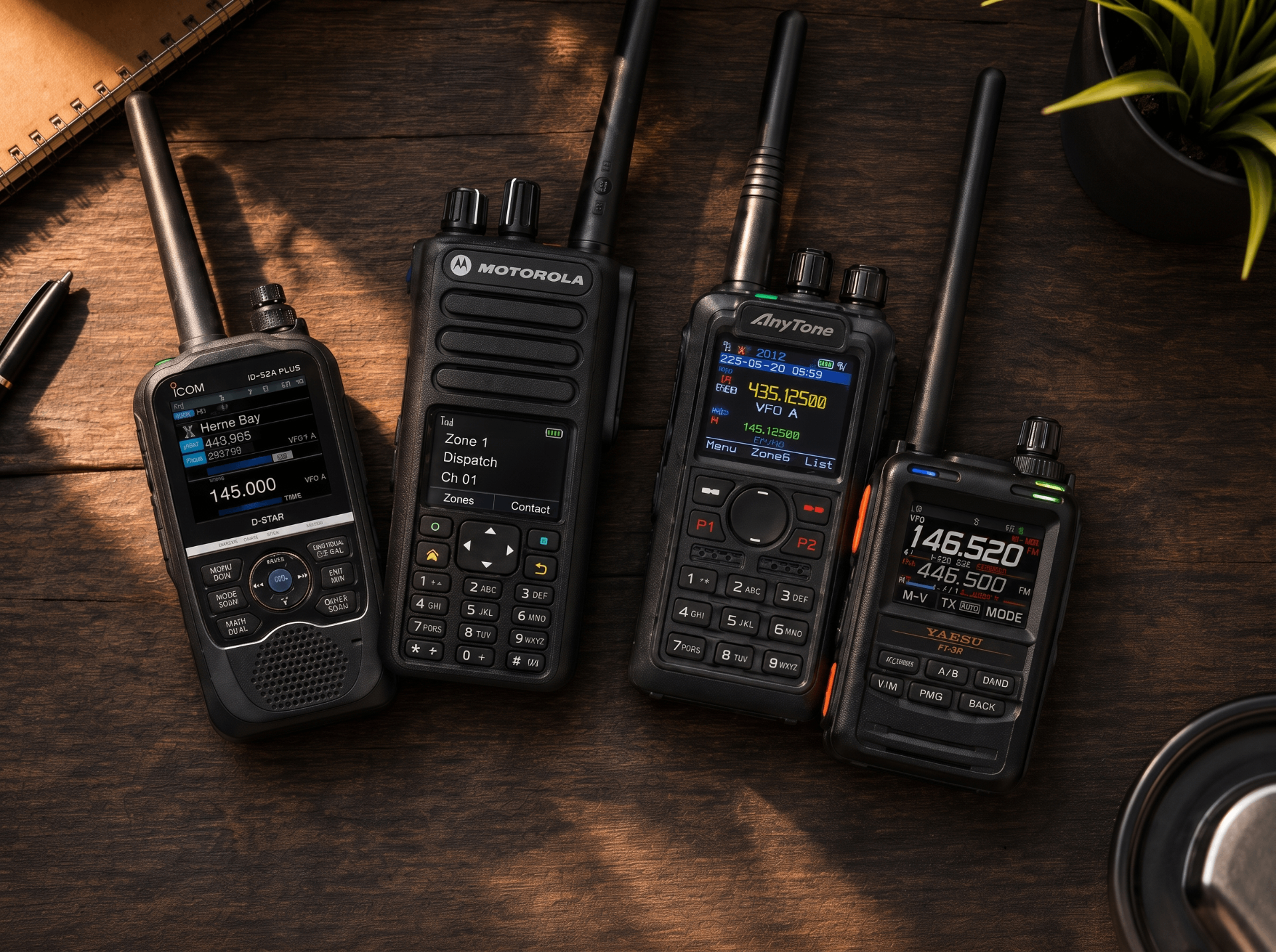
DMR offers a large and flexible ecosystem with extensive networking possibilities, but usually asks the operator to learn more terminology and programming.
D-STAR provides a mature, amateur-focused system built heavily around callsigns and ham-specific networking.
System Fusion offers an approachable combination of analog FM and C4FM digital voice, particularly for operators already interested in the Yaesu ecosystem.
P25 occupies a more specialized corner of amateur radio and can be especially rewarding for operators interested in commercial and public-safety radio technology.
Those aren’t rankings. They are different paths into roughly the same broader goal: using digital technology to expand what you can do with VHF and UHF voice communications.
Let Your Operating Environment Make the Decision
Digital voice is easy to evaluate as a technology contest, but amateur radio doesn’t happen on a specification sheet.
The repeater your club uses every week may be more valuable to you than a technically impressive network with no local users. Likewise, an operator interested in worldwide conversations through a hotspot may place much less importance on what repeaters are available nearby.
Before buying your first digital voice radio, spend some time exploring the systems already around you. Check repeater listings, listen to local activity, talk with clubs and repeater owners, and find out where the conversations you want to join are happening.
You don’t necessarily have to stay with one system forever. Digital voice is another part of amateur radio to explore, and plenty of operators eventually use more than one mode.
The best place to start is the one that gets you on the air, into conversations, and interested in learning what comes next.