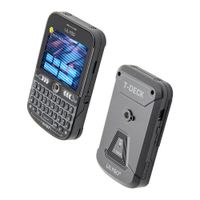
The LILYGO T-Deck is an all-in-one pocket terminal designed for untethered off-grid mesh communications and embedded microcontroller experimentation. Built around the dual-core ESP32-S3 processor and an onboard Semtech SX1262 LoRa transceiver, the T-Deck breaks free from the traditional requirement of pairing a radio node to a smartphone over Bluetooth. By integrating a physical US QWERTY mini-keyboard, an optical trackball, and a vibrant 2.8-inch IPS color display into a unified handheld form factor, it provides radio operators, makers, and emergency communications volunteers with a true zero-infrastructure text terminal built for the Meshtastic ecosystem and custom off-grid digital networks.
Dedicated Standalone Mesh Messaging Architecture
The core engineering advantage of the T-Deck is its independence from external client hardware. Standard headless LoRa nodes require a continuous Bluetooth or Wi-Fi link to a companion phone running an app to compose, send, and read encrypted packets. If the phone battery depletes or the connection drops in rough field conditions, communications halt. The T-Deck incorporates a complete physical keyboard and a 320 × 240 IPS screen directly onto the bus, permitting direct node navigation, channel changes, cryptographic key validation, and end-to-end message transmission straight from the palm of your hand.
Under the hood, the Semtech SX1262 radio engine delivers up to +22 dBm (approx. 160 mW) of transmit power across regional ISM bands (including 915 MHz for North America and 868 MHz for Europe). When coupled with standard spread-spectrum LoRa modulation, this output budget yields superior link margins, allowing messages to dig beneath the RF noise floor and hop across decentralized mesh relays over miles of challenging terrain.
High-Performance ESP32-S3 Processing & Open Extensibility
Driving the display, keyboard matrix, peripheral buses, and radio stack is Espressif’s ESP32-S3FN16R8 SoC. With dual Xtensa 32-bit LX7 cores running at up to 240 MHz, alongside a generous 16MB of Flash and 8MB of Octal PSRAM, the T-Deck easily manages complex framebuffers, graphical user interfaces, dynamic mesh routing tables, and local packet databases without out-of-memory bottlenecks.
For developers, the board functions as an open sandbox supported across Arduino IDE, PlatformIO, and MicroPython. Beyond mesh firmware like Meshtastic and MeshCore/Chatterbox, the hardware accommodates tactical field applications including pocket packet sniffers, terminal emulators, off-grid BBS relays, or portable digital audio communicators utilizing the onboard microphone, class-D speaker circuitry, and TF/MicroSD slot.
Hardware Configurations & Field Integration
The platform is available across multiple modular tiers to match deployment requirements. The unencased Base model provides raw access to expansion headers, ADC battery telemetry pins (IO04), and the open circuit board for custom enclosure 3D printing and hardware prototyping. Higher integration tiers—such as the factory T-Deck Plus or customized field-ready kits from authorized distributors—add tailored enclosures, internal or external GPS modules via onboard peripheral expansion, high-capacity lithium-polymer power cells (2000 to 3000 mAh), and external SMA antenna interfaces for mounting higher-gain whips.
Battery connectivity is supplied via a 2-pin connector tied directly to onboard charging and management ICs, enabling quick recharging through standard 5V USB-C ports while simultaneously supporting serial data and firmware re-flashing.